Get to know the terms related to the electricity network
Electrical terms may raise questions. This page summarises key concepts such as electricity connection, delivery site and network service, and also helps you to understand the basics of the electricity bill.
Electricity network terms
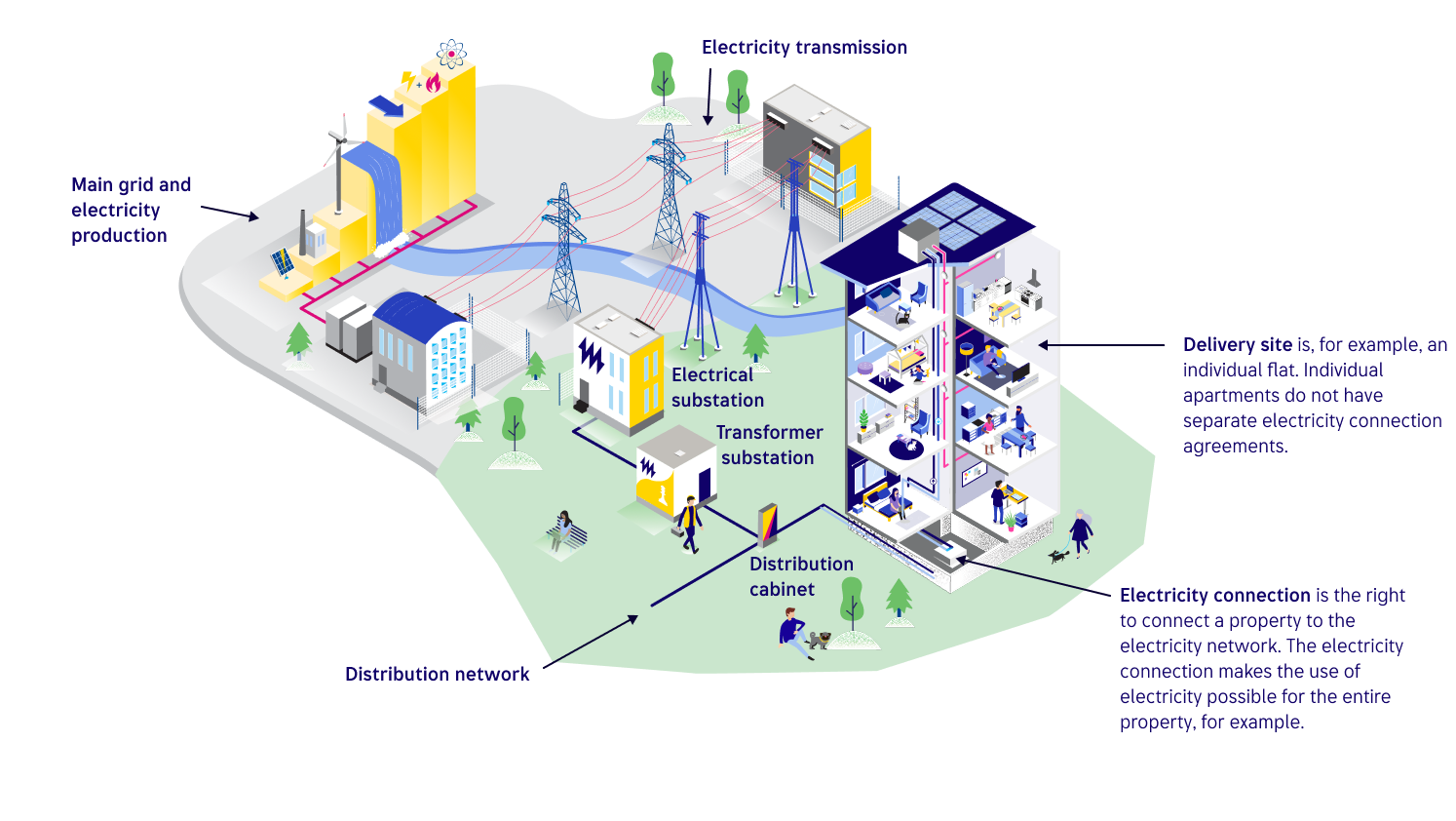
Electricity connection? Delivery site? Electricity contract? If you are not yet familiar with these terms, the image below will help you understand more.
Electricity connection and connection agreement
Electricity connection refers to the right to use electricity and the electricity network built to the connection point, which links the property to the distribution network. An electricity connection requires a connection agreement that agrees on the details of the connection, such as the size of the main fuse, delivery time, location of the connection point, connection fee and the owner of the connection. A physical connection is usually built in connection with other construction work when electricity is needed for a plot or property.
- In apartment buildings and terraced houses, the connection is owned by the housing company or property owner.
- Individual flats do not have their own connection agreements.
- In detached houses and other properties, the connection is typically owned by the owner of the plot or building.
Delivery site
Under the electricity connection, there is a delivery site or delivery sites, such as flats in apartment buildings or other premises, the electricity consumption of which is metered with an electricity meter.
- When the customer concludes an electricity contract with the electricity supplier of their choice, they provide the seller with the address of the delivery site.
- The electricity supplier notifies the network company of the electricity contract, which automatically concludes a network service contract for the same delivery site. The agreement specifies the network service product for the delivery site.
Below, you can also familiarise yourself with other key terms related to an electricity network company’s operations and electricity distribution.
Get to know the terms used in your electricity bill
In the invoice, electrical energy refers to the energy and service provided by the electricity seller. The amount of energy billed is most commonly based on the amount of electricity used during the invoicing period, measured as kilowatt-hours (kWh).
Electricity network service refers to the transmission of electricity produced in power plants to electricity users along the electricity network, i.e. electricity transmission. The network service fee consists of several components.
The network service fee also covers year-round network monitoring and fault repair, electricity consumption metering and customer services, such as online reporting of consumption data. In addition, the network service fee is used to maintain the electricity network and finance investments in the new electricity network as well as to cover the costs caused by capital tied up in the network.
In addition, network service fees cover the costs caused by losses in the electricity network and compensation paid to the transmission system operator for national electricity transmission. The network service fee typically consists of a fixed fee and a variable component based on consumption.
The network service is provided by a local electricity network company, such as Helen Electricity Network Ltd in Helsinki. The task of the electricity network is to transmit the electricity generated in power plants to electricity users. The costs of maintaining the electricity network are covered by network service product fees, and the Energy Authority monitors that the prices are reasonable.
Electricity tax is paid on electricity consumption and consists of excise duty on electricity and a security of supply fee. The electricity network company invoices the electricity tax to the customer in connection with the distribution fee and forwards it to the state.
A kilowatt-hour is a unit of energy equivalent to 1000 watt-hours. Watt-hour (Wh) is a unit of energy equivalent to one watt of power for one hour. When measuring the amount of electrical energy, kilowatt-hours (kWh) are usually used.